Thursday, January 19, 2017

CMS Awards $66.1 Million in American Samoa, Puerto Rico, the U.S. Virgin Islands and Florida to Fight Zika


CMS NEWS


FOR IMMEDIATE RELEASE
January 18, 2017

Contact: CMS Media Relations
(202) 690-6145 |
CMS Media Inquiries


CMS Awards $66.1 Million in American Samoa, Puerto Rico, the U.S. Virgin Islands and Florida to Fight Zika

Today, the Centers for Medicare & Medicaid Services (CMS) announced $66.1 million in funding to health departments in American Samoa, Puerto Rico, the U.S. Virgin Islands, and Florida to help combat the Zika virus.  Congress authorized this funding in the Continuing Appropriations and Military Construction, Veterans Affairs, and Related Agencies Appropriations Act, 2017, and Zika Response and Preparedness Act (P.L. 114-223).

Zika remains a serious health concern, as Zika virus infection during pregnancy has been linked to fetal death and other adverse birth outcomes; including microcephaly and other potentially severe fetal brain defects.  In addition, the Centers for Disease Control and Prevention (CDC) note that several countries that have experienced Zika outbreaks recently have reported an increase in the number of people who have Guillain-BarrĂ© syndrome, a sickness that causes damage to a person’s nerve cells.

In accordance with the Zika Response and Preparedness Act (P.L. 114-223), entities eligible for this funding opportunity included states, territories, tribes or tribal organizations with active or local transmission of the Zika virus, as confirmed by the CDC.  At the time of the funding opportunity announcement, on November 9, 2016, the CDC designated American Samoa, Puerto Rico, the U.S. Virgin Islands, and Florida as areas with laboratory-confirmed active or local Zika virus transmission.  As such, this emergency funding opportunity was only available to the territorial and state health departments in these areas.  There are states with laboratory-confirmed Zika cases that were not currently eligible for these funds because the cases are travel associated and not locally acquired.

Through these awards, $66.1 million is available over a three-year period, with $60.6 million directed to Puerto Rico, which has the highest incidence of locally transmitted Zika cases.  Allocations of funds are based on the percent of active and local Zika cases reported by the CDC and the size of the populations in these areas.  Funds will support prevention activities and treatment services for health conditions related to the Zika virus, including improving provider capacity and capability. 

“This funding will help prevent the spread of the Zika virus and meet the health needs of people who have been infected” said Vikki Wachino, Deputy Administrator, CMS, Director, CMCS.    

Type 2 Diabetes Rose 109% in Children From 2011-2015


FAIR Health recently released a white paper on obesity and type 2 diabetes in private claims data from 2011-2015. Here are some key findings from the report:

Among preschoolers (ages 3-5), the diabetes increase was 90% from 2011 to 2015.
From 2011 to 2015, obesity diagnosis grew by 191% for adults over age 22.
In the age group 19-22 years, the increase in obesity claim lines was 154%.
Claim lines with a type 2 diabetes diagnosis increased 109% for ages 0-22.
Obstructive sleep apnea rose in the pediatric population by 161%.
Hypertension rose by 67% in the pediatric population age 0-22.


Source: FAIR Health, January 2017

Tuesday, January 17, 2017

Sharp reduction in avoidable hospitalizations among long-term care facility residents


January 17, 2017
By Niall Brennan, Director of the CMS Office of Enterprise Data and Analytics, and CMS Chief Data Officer; and, Tim Engelhardt, Director of the Federal Coordinated Health Care Office at CMS

Data Brief: Sharp reduction in avoidable hospitalizations among long-term care facility residents 

For long-term care facility residents, avoidable hospitalizations can be dangerous, disruptive, and disorienting. Keeping our most vulnerable citizens healthy when they are residents of long-term care facilities[1] and reducing potentially avoidable hospital stays has been a point of emphasis for the Centers for Medicare & Medicaid Services (CMS).
Over the last several years, with the help from the Affordable Care Act, Medicare and Medicaid have worked with other federal government agencies, states, patient organizations, and others to identify and prevent those health conditions that have caused long-term care residents to be unnecessarily hospitalized. Because of these efforts, we have seen a dramatic reduction in avoidable hospitalizations over the last several years, according to below analysis released by CMS today. 
In 2001, the Agency for Healthcare Research and Quality (AHRQ) first identified a set of measures designed to identify hospitalizations that could potentially be avoided with appropriate outpatient care. They include hospital admissions for largely preventable or manageable conditions like bacterial pneumonia, urinary tract infections, congestive heart failure, dehydration, and chronic obstructive pulmonary disease. More recently, CMS’s own Office of Enterprise Data and Analytics found that instances of these potentially avoidable hospitalizations (PAH) were disproportionally high among some of our nation’s most vulnerable people, those dually eligible for Medicare and Medicaid living in long-term care facilities.
Treating conditions before hospitalization and preventing these conditions whenever possible would not only help long-term care facility residents stay healthy, but may also save Medicare and Medicaid money. After carefully examining this problem, CMS and others focused on reducing the instances of potentially avoidable hospitalizations from these facilities.  
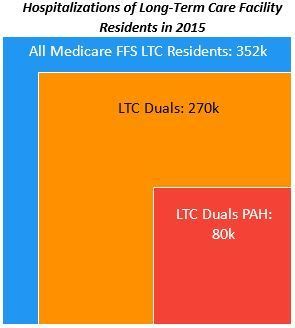
Hospitalizations of Long-Term Care Facility      Residents in 2015
In 2015, Medicare fee-for-service (FFS) beneficiaries living in long-term care facilities had a total of 352,000 hospitalizations. Of this number, Medicare beneficiaries eligible for full Medicaid benefits living in long-term care facilities (LTC Duals) accounted for 270,000 hospitalizations. And, almost a third (approximately 80,000) of these hospitalizations were caused by six potentially avoidable conditions: bacterial pneumonia, urinary tract infections, congestive heart failure, dehydration, chronic obstructive pulmonary disease or asthma, and skin ulcers.
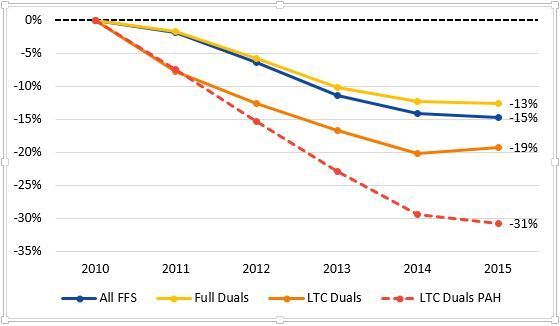
Through the concerted effort by CMS and many other to address these potentially avoidable conditions, real progress has been made to improve the health and wellbeing of some of our country’s most vulnerable citizens. In recent years, the overall rate of hospitalizations declined by 13 percent for dually eligible Medicare and Medicaid beneficiaries. But we have seen even larger decreases in hospitalization rates for potentially avoidable conditions among beneficiaries living in long-term care facilities.  Specifically, between 2010 and 2015, the hospitalization rate for the six potentially avoidable conditions listed above decreased by 31 percent for Medicare and Medicaid dually-eligible beneficiaries living in long-term care facilities.
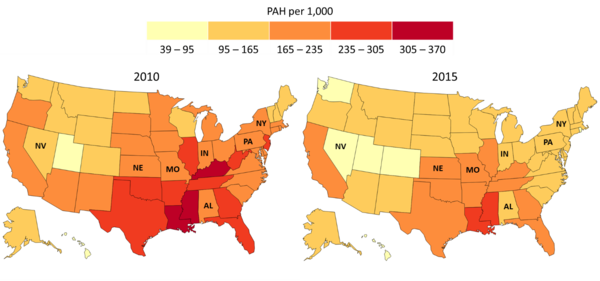
In 2010, the rate of potentially avoidable hospitalizations for dually-eligible beneficiaries in long term care facilities was 227 per 1,000 beneficiaries; by 2015 the rate had decreased to 157 per 1,000.[1] This decrease in potentially avoidable hospitalizations happened nationwide, with improvement in all 50 states. The reduced rate of potentially avoidable hospitalizations means that dually-eligible long-term care facility residents avoided 133,000 hospitalizations over the past five years.
Percent Change in Medicare Hospitalization Rates Since 2010

Note: FFS (fee-for-service), LTC (long-term care facility), PAH (potentially avoidable hospitalization)

Potentially Avoidable Hospitalization Rates for Dual-Eligible Beneficiaries Living in Long-Term Care Facilities, by State

Potentially Avoidable Hospitalization Rates for Dual-Eligible Beneficiaries Living in Long-Term Care Facilities, by State
Note: Labeled states contain facilities in the CMS “Initiative to reduce avoidable hospitalizations among long-term care facility residents”, discussed below.
This success would not be possible without the committed work by those who directly serve older adults and people with disabilities. We also should consider the range of other contributing factors, including:
  • An initiative launched in 2011 by the Medicare-Medicaid Coordination Office, CMS Innovation Center, and other partners to reduce avoidable hospitalizations among nursing facility residents in seven sites across the country.[1] This initiative aimed at keeping dually-eligible long-term care residents healthy by focusing on preventable conditions that lead to hospitalizations.[2]
  • The AHRQ Safety Program for Long-Term Care significantly reduced catheter-associated urinary tract infections in hundreds of participating long-term care facilities nationwide, which helped prevent a recognized cause of hospitalizations in residents of these facilities.
  • This work is in addition to the many other efforts and initiatives, including the Hospital Readmission Reduction Program, and systemic efforts to reduce readmissions through the Partnership for Patients;
  • The efforts to align care with quality through Accountable Care Organizations, the Bundled Payments for Care Improvement models, and other delivery system reforms;
  • And, finally, the countless other industry-led initiatives focusing on quality improvement and specifically reducing hospitalization rates among long-term care facility residents.
This success shows that a sustained commitment to smarter spending across the entire health care system can yield dramatic results and improve the lives of vulnerable Americans. These results are also consistent with other ongoing collaborative efforts to improve the quality of care patients received through preventing hospital-acquired conditions where approximately 125,000 fewer patients died due to hospital-acquired conditions and more than $28 billion in health care costs were saved from 2010 through 2015.   
Finding the best possible long-term care facility care for a loved one is one of the most difficult decisions family members can make. Family members want to be assured that their loved one will receive the highest quality of care in a healthy environment. And thanks to efforts across the health care industry, and with tools from the Affordable Care Act that allow CMS to improve quality and test innovative strategies, these residents are living in safer, healthier environments.
###
[1] The seven sites were: Nevada, Nebraska, Montana, New York, Pennsylvania, Indiana, and Alabama. Note that six of these sites have continued into “Phase II” of the Initiative, which launched in October 2016.
[2] For more information, see the Initiative website at: https://innovation.cms.gov/initiatives/rahnfr/
[3] The seven sites were: Nevada, Nebraska, Montana, New York, Pennsylvania, Indiana, and Alabama. Note that six of these sites have continued into “Phase II” of the Initiative, which launched in October 2016.
[4] For more information, see the Initiative website at: https://innovation.cms.gov/initiatives/rahnfr/

Large Doctor's Offices Are Paid $14/Visit More Than Small Offices


Health Affairs recently published a study on reimbursement differences between small and large insurers and doctor's offices. Here are some key findings from the report:

Small insurers (5%- market share) are billed $86 for a routine doctor's office visit.
Medium insurers are billed $70 for a routine doctor's office visit.
Large insurers (15%+ market share) are billed $68 for a routine visit.
Small doctor's offices are paid $72 average for a routine visit.
Medium doctor's offices are paid $77 average for a routine visit.
Large doctor's offices are paid $86 average for a routine visit.

 
Source: The Washington Post, January 9, 2017

CMS partners with commercial and state insurers to support primary care practices and reduce clinician burden


January 17, 2017      

By       Dr. Vindell Washington, National Coordinator for Health Information Technology (ONC) and
           Andy Slavitt, Acting Administrator, Centers for Medicare & Medicaid Services (CMS)


CMS partners with commercial and state insurers to support primary care practices and reduce clinician burden


Data is the lifeblood of the value-based payment environment. Every time a doctor takes care of a patient, we have an opportunity to use information in ways that help patients get better care. The goal is to use the information from each patient encounter to make the next encounter better – across the entire healthcare system. But it is easier said than done. As we prepare to transition from this administration, we’d like to take stock of what our nation has accomplished and to lay out a potential roadmap for the next administration.

Making data easy to use begins by putting it into secure, private, digital form. During the past seven years, we've made remarkable progress towards this goal: in 2015, over 77 percent of office-based physicians reported using a certified electronic health record (EHR) to inform clinical care, while the percentage of office-based physicians with any EHR has doubled since 2008. As we hoped, digital tools have helped us reduce medical errors by, for example, e-prescribing and having fewer follow up items fall between the cracks. But we still have a lot of work to do.

While the tools are improving, some clinicians remain frustrated by the limited usability of their technology and data, from their inability to easily enter and access key information when and where they need it at the point of care to challenges in accessing timely feedback on the quality of care in their practice. We need 21st century information technology, enabling ready and secure data access, to support a modern, value-based healthcare system.

New Tools

One obstacle is the efforts of some vendors to put up barriers to sharing data. Fortunately, the bipartisan 21st Century Cures Act, which was enacted in December 2016, takes a significant step toward overcoming that obstacle. The Act advances interoperability through several provisions including the prohibition of information blocking and authorization of penalties of up to $1 million per violation. The law also gives ONC new authority to address usability and interoperability through additional conditions of certification for health information technology (health IT) developers related to: access, use, and exchange of electronic information; usability, security, and business practices; real-world testing; and publishing application programming interfaces (APIs).

We have also launched new tools to address these challenges under the recently established Quality Payment Program (QPP). This program created by the Medicare Access and CHIP Reauthorization Act of 2015 (MACRA) uses a number of tools to reward Medicare clinicians for quality of care over quantity of services provided. These tools include a web application and public API designed to help clinicians, registries, and others in the CMS vendor community more easily share and receive feedback about performance. By consolidating previous programs such as the Physician Quality Reporting System (PQRS) and the EHR Incentive Programs (Meaningful Use); creating more ways for clinicians to participate; significantly reducing requirements by reducing the  number of measures; and providing additional flexibility in selecting meaningful measures, QPP also reduces administrative burden.

Yet the Department of Health and Human Services (HHS) recognizes that clinicians work with many payers, not just Medicare alone; in fact, the average physician practice now contracts with 12 different insurers. And that can lead to an additional set of challenges: access to data across disparate payers and settings is variable; the lack of comparability from multiple sources makes it hard to obtain actionable insights to inform care; and clinicians face increased administrative complexity if they participate in alternative payment model programs tied to different payers, each with unique requirements around quality measures, formats, and submission methods.

A Vision For The Future

We must overcome these challenges to enable clinicians to continuously improve quality and to ensure the nation gets more value from each healthcare dollar. That’s why HHS envisions a future where clinicians in a multi-payer environment obtain actionable, reliable, and comprehensive feedback data regardless of who pays for their patients’ care. HHS also envisions streamlined quality reporting, where clinicians collect data as part of the normal course and share it at the push of a button with any authorized party. Finally, HHS will continue to work towards minimizing the financial and administrative burden of collecting and reporting information on clinicians and practices, especially small practices and those in rural and underserved areas.

The federal government should only play a modest role in the ecosystem necessary to support patients and physicians. We believe that ecosystem requires the following six elements to ensure a data-rich, patient-centered, and value-based health care system:

  1. Seamless interaction between point of care solutions and other entities, including through the use of standard APIs. Health IT developers can play a key role in this vision by making it easier for clinicians to share data between their EHRs and other applications or services, such as registries, empowering clinicians to assemble the right tools and services for their practice.
  2. Growth of third-party entities that can meet provider data access and reporting needs. Clinicians will benefit from a robust marketplace of trusted entities that can perform core functions like facilitating quality reporting to all payers, combining data from disparate sources of care in a medical neighborhood and presenting it in a usable way, and helping clinicians to understand data on their patients—at a reasonable cost. For instance, vendor partners working with select regions participating in the Comprehensive Primary Care initiative have made important progress in recent years by providing aggregate feedback reports including data from both Medicare and commercial payers.
  3. Use of low-cost shared services necessary for aggregating and linking data. Value-based payment relies on a variety of core services, such as accurate information on the identity of patients and providers to carry out key tasks like attributing patients to providers. Stakeholders could realize significant efficiencies by coming together around shared governance and financing for such services. Many of the participants in the Center for Medicare and Medicaid Innovation (CMMI) State Innovations Model have taken just such an approach.
  4. Greater data transparency and data consolidation. Efforts like state All Payer Claims Databases and Medicare Qualified Entities that bring together data from multiple payers in one place can provide stakeholders with a single place to go for data, while reducing the burden on the payers who want to make their data available.
  5. Standardization of key patient data needed for quality measurement. ONC and CMS can assist in fostering ongoing standardization of data for measures as well as development of related tools, such as libraries of data elements that allow new electronic measures to be easily captured, calculated and reported for use by clinicians and consumers. 
  6. Alignment around how quality is measured and reported across payers. By coming together around common quality measures and reporting mechanisms payers can ensure clinicians have access to more useful, aggregated performance feedback, while increasing the comparability and auditability of measurement results. Efforts such as the Health Care Payment Learning and Action Network, and the Core Quality Measurement Collaborative (which identified 7 core sets of quality measures that CMS and commercial payers have committed to using) have begun to make such alignment possible.

HHS has heard a great deal about the challenges clinicians are facing as they look towards value-based care. As HHS leaders continue this crucial dialogue, we look forward to hearing from you about what’s working today and what’s not, as well as your ideas about what the Federal Government and the private sector can do to make progress in this area.

It’s been a great honor working with the health care community and serving the American public. Working together across the health care landscape, the nation can move towards a truly 21st century data infrastructure that frees clinicians to confidently transition to value-based payment and realize better care, smarter spending, and healthier people.

Friday, January 13, 2017

Nearly 12 million people with Medicare have saved over $26 billion on prescription drugs since 2010


CMS NEWS


FOR IMMEDIATE RELEASE
January 13, 2017 

Contact: CMS Media Relations
(202) 690-6145 | CMS Media Inquiries


Nearly 12 million people with Medicare have saved over $26 billion on prescription drugs since 2010
Over 40 million Medicare beneficiaries utilized free preventive services in 2016

The Department of Health and Human Services released today new information that shows that millions of seniors and people with disabilities with Medicare continue to save on prescription drugs and see improved benefits in 2016 as a result of the Affordable Care Act.                                                                                                                     

More than 11.8 million Medicare beneficiaries have received discounts over $26.8 billion on prescription drugs – an average of $2,272 per beneficiary – since the enactment of the Affordable Care Act. In 2016 alone, over 4.9 million seniors and people with disabilities received discounts of over $5.6 billion, for an average of $1,149 per beneficiary. This is an increase in savings compared to the 2015 information released this time last year, when 5.2 million Medicare beneficiaries received discounts of $5.4 billion, for an average of $1,054 per beneficiary.

Medicare beneficiaries also continue to take advantage of certain recommended preventive services with no coinsurance:  

  • An estimated 40.1 million people with Medicare (including those enrolled in Medicare Advantage) took advantage of at least one preventive service with no copays or deductibles in 2016, slightly more than in 2015.
  • More than 10.3 million Medicare beneficiaries (including those enrolled in Medicare Advantage) took advantage of an Annual Wellness Visit in 2016. Looking just at original Medicare, nearly one million more people utilized an Annual Wellness Visit in 2016 than 2015 (more than 6.6 million compared to nearly 5.8 million).

"While the Affordable Care Act has expanded coverage to 20 million Americans, the law is also a game changer for millions of older Americans,” said Centers for Medicare & Medicaid Services (CMS) Acting Administrator Andy Slavitt. "These benefits are providing seniors and people with disabilities with Medicare coverage increased financial security and the guarantee that they can get an important preventive screening without cost to them.”

Today’s announcement is part of the Administration’s broader strategy to improve the health care system by paying providers for what works, unlocking health care data, and finding new ways to coordinate and integrate care to improve quality. The Affordable Care Act provides tools – such as providing certain recommended preventive services at no cost sharing and closing the Medicare Part D “donut hole” – to make our health care system more affordable for patients and move it toward one that rewards doctors based on the quality, not the quantity of care they give patients. In addition, Medicare exceeded – earlier than predicted – the Administration’s goal to tie more than 30 percent of fee-for-service payments by the end of 2016 through alternative payment models to quality and cost metrics. Medicare is on pace to reach 50 percent by the end of 2018.

Closing the prescription drug “donut hole”

The Affordable Care Act makes Medicare prescription drug coverage more affordable by gradually closing the gap in coverage during which beneficiaries had to pay the full cost of their prescriptions out of pocket, after hitting their initial coverage limit, and before catastrophic coverage for prescriptions took effect. The gap is known as the donut hole. Because of the Affordable Care Act, the donut hole has been narrowing each year, and will be closed by 2020.   

Because of the health care law, in 2010, anyone with a Medicare prescription drug plan who reached the prescription drug donut hole received a $250 rebate. In 2011, beneficiaries in the donut hole began receiving discounts and savings on covered brand-name and generic drugs. People with Medicare Part D who are in the donut hole in 2017 will receive discounts and savings of 60 percent on the cost of brand name drugs and 49 percent on the cost of generic drugs.  

For state-by-state information on discounts in the donut hole, go to: https://downloads.cms.gov/files/Part%20D%20Donut%20Hole%20Savings%20by%20State%20YTD%202016.pdf.

For more information about Medicare prescription drug benefits, go to: http://www.medicare.gov/part-d/.

Medicare preventive services

The Affordable Care Act added coverage of an annual wellness visit and eliminated coinsurance and the Part B deductible for certain recommended preventive services covered by Medicare, including many cancer screenings and other important benefits. By making certain preventive services available with no cost sharing, the Affordable Care Act removes barriers to prevention, helping Americans take charge of their own health and helping individuals and their providers better prevent illness, detect problems early when treatment works best, and monitor health conditions.

For state-by-state information on utilization of an annual wellness visit and preventive services at no cost to Medicare beneficiaries, please visit: https://downloads.cms.gov/files/Beneficiaries%20Utilizing%20Free%20Preventive%20Services%20by%20State%20YTD%202016.pdf.

Thursday, January 12, 2017

1,190 Children Are Projected to Die From Cancer in 2017


The American Cancer Society recently released projections for cancer rates in American children for 2017. Here are some key findings from the report:


Cancer is the 2nd leading cause of death in children ages 1-14, after accidents.
In 2017, an estimated 10,270 children 1-14 will be diagnosed with cancer.
1,190 children are projected to die from cancer in 2017.
Leukemia accounts for almost a third (29%) of all childhood cancers.
26% of childhood cancers are brain and other nervous system tumors.
Cancer incidence rates increased in children by 0.6% per year from 1975-2013.


Source: American Cancer Society, January 5, 2017